Showing posts with label Cataract Awareness Month. Show all posts

Tuesday, August 13, 2013

Recent Advances Improve Outcomes for Cataract Patients


Nearly half of the world’s blindness is caused by age-related cataracts. In the United States alone, 5 million people have diminished vision due to cataracts, including over half of those 80 years and older.

Yet cataracts are among the most treatable vision problems. Revolutionary advances in surgery and the development of sophisticated lens replacements have not only restored vision to millions, but have actually improved vision for many by correcting other lens-related defects.

The American Academy of Ophthalmology has designated August as Cataract Awareness Month, and as a part of that effort the physicians of Hattiesburg Eye Clinic want to get the word out about the effects of cataracts on vision and what can be done about it.

“Cataracts are a part of the aging process,” says Dr. Stoney Williamson. “Anyone 50 and over is going to have some form of cataracts that get progressively worse. At what point they may need treatment will depend on how much the cataracts have diminished their daily activity.”

The eye’s natural lens, a transparent structure between the iris and the retina consists mainly of water and protein. Light waves entering the eye pass through the lens and are focused on the retina, a layer of photoreceptor nerve cells at the back of the eye. The retina converts the light rays into electrical impulses that are then transmitted to the brain as sight by way of the optic nerve.

As we age, though, some of the lens’s protein will begin to clump and cause a cloudy area – a cataract – to develop in the lens. As the cataract enlarges, the increased clouding distorts or light passing through the lens. The person’s vision blurs (sometimes resulting in double vision or multiple images), colors fade and night vision becomes poor. In time, the person’s ability to see anything clearly fails altogether.


Surgery to remove the clouded lens has been a standard treatment for decades. In the last twenty years, however, cataract surgery has taken a quantum leap – advances in laser technology and the introduction of the intraocular lens (IOL) have turned the procedure into an outpatient treatment that takes only a few minutes to perform, with a shorter recuperative period and better long-term outcomes.

“I don’t believe I can even remember how to perform cataract surgery as we did when I first entered practice,” says Dr. Williamson, “that’s how much has changed. We’ve seen a 45-minute procedure with an overnight hospital stay and a long recovery period become a ten-minute procedure where the patient goes home the same day and can resume anything but strenuous activity almost immediately.”


The key to current state-of-the-art cataract treatment is the IOL. According to Dr. David Richardson, there are three basic types of these artificial lenses that permanently replace the clouded lens that is removed during surgery. And all of them can correct vision problems associated with the natural lens not related to cataracts.

“The standard IOL can correct far-sighted vision and to some extent near-sighted, but not astigmatism,” says Dr. Richardson. “A toric lens takes it one step further and can correct for astigmatism. The third type, the multi-focal, can correct all of these categories, including intermediate distance vision.”

Sunday, August 4, 2013

Famed Child Star’s Vision Restored by Small Incision/No Stitch Cataract Surgery


Eddie Hodges and Dr. Richardson

August is Cataract Awareness Month

The people and places Eddie Hodges has seen – and much of that by the age of 10. By the time he’d reached his teenage years in the early 1960s, the renowned child star had worked with actors like Robert Preston and Henry Fonda on Broadway, and in various movie and television locations like New York, Florida and California with stars like Frank Sinatra and Elvis Presley.

But while those sights from the past remain vivid and clear in his memory, his ability to see now, up until recently, wasn’t so clear. Now in his mid-sixties, Hodges had developed cataracts. Thanks to Hattiesburg Eye Clinic, though, his vision will be just fine – he recently underwent a small incision/no stitch cataract surgery performed by Dr. David Richardson.

Hodges had shown a talent for entertaining very early in life (his first “job” was at eighteen months singing “Jesus Loves Me” as he was held up to the microphone). His family moved to New York City when he was a child and through his father’s efforts he landed a few bit parts in television shows and commercials.

His big break came around the age of ten when a talent scout he chanced to meet in Central Park led him and his family to the producers of the game show “Name That Tune.” He became a contestant on the show and was soon paired with another contestant – future astronaut John Glenn (at the time a military test pilot). They went on to appear in several broadcasts of the show. One of the program’s avid fans was the wife of Meredith Wilson, who at the time was organizing a new Broadway musical called, “The Music Man.” He had hit a snag casting the part of Winthrop, a young boy in the play.

“We found out later when she saw me on ‘Name that Tune’ that she called her husband and told him she had found his Winthrop,” says Hodges.

Hodges auditioned and got the part, playing Winthrop in the smash hit for the next year. This led to a motion picture role with Frank Sinatra in “A Hole in the Head,” and from there a continuous stream of work in movies, television and recording.

Hodges, as a child, with Frank Sinatra

Hodges had the rare opportunity to meet many performers during this time: Sinatra (“wonderful to work with”), director Otto Preminger (“a very difficult man”), Henry Fonda (“quiet, but powerful”) and Archie Moore, who played Big Jim opposite his Huckleberry Finn in “The Adventures of Huckleberry Finn” (1960). In his final years in show business, he also worked with Elvis Presley in the movie “Live a Little, Love a Little.”

“Elvis was great to work with,” Hodges said. “We were both from the south, so we hit it off. We talked about squirrel hunting, and he showed me some karate moves.”

But while the performing life could be glamorous it was also demanding. Hodges grew tired of the rigorous schedule. Wanting to live a more normal life, he enrolled in high school to be around young people his age. After being drafted into the military, he returned to Los Angeles briefly after his hitch, but his desire for show business had waned.

He moved to Mississippi, where his mother lived after she and his father had divorced, and enrolled in college. After earning a master’s degree in counseling psychology, he worked in community mental health on the coast, and then for a time in private practice. He eventually moved to Hattiesburg to work with Pine Belt Mental Health, where he worked until his retirement last year.

While his mind’s eye remained sharp as ever, cataracts had diminished sight in his physical eyes. This progressive clouding of the eye’s natural lens caused his vision to significantly blur. The only treatment for cataracts is the surgical removal of the natural lens and the implantation of an artificial intra-ocular lens (IOL).

Hodges chose Dr. Richardson to perform the surgery, based on his mother’s experience.

“My mother had undergone the same procedure with Dr. Richardson, and recommended him,” says Hodges. “I was immediately impressed with him. He’s a gifted surgeon and very attentive.”

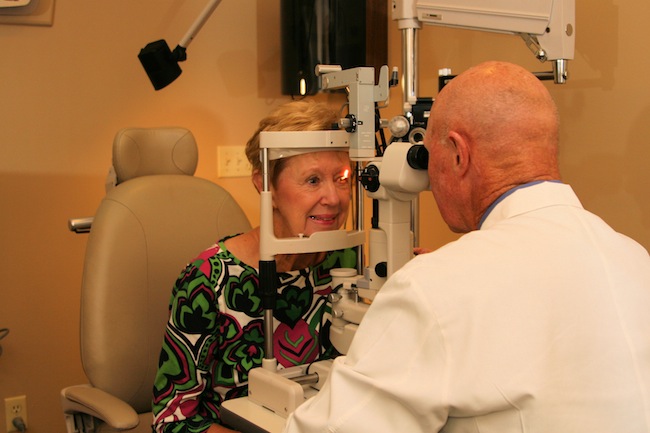
Dr. Richardson examining Hodges' eyes.

For his surgery, Hodges selected a Tecnis multi-focal IOL. This type of lens also corrects other issues with the eye secondary to the immediate problem caused by the cataracts.

“The Tecnis lens enables many patients to see near again without glasses, and to actually function ninety to one hundred percent of the time without them,” says Dr. Richardson. “We have a lot of patients who’ve been wearing glasses since they were very young children. Many can’t believe they can see this well now without their glasses.”

“I was amazed when he performed the first surgery on my left eye,” says Hodges. “He gave me something to read and I could do it without glasses. It’s been a long time since I could do that.”

Hodges’ new set of eyes means he’ll be recording a lot of new memories with his children and grandchildren to add to his collection from his glamour days on Broadway and in Hollywood.

“I’ve really been blessed to have been able to do something I really wanted to do,” says Hodges. “As a little kid I had prayed to God to be able to be a singer. Things just fell into place – and I’m thankful I was able to use the gifts God gave me.”